ATEAM Productions is a Singapore-based AV production company specialising in multi-camera livestreaming, live sound and LED displays for events.
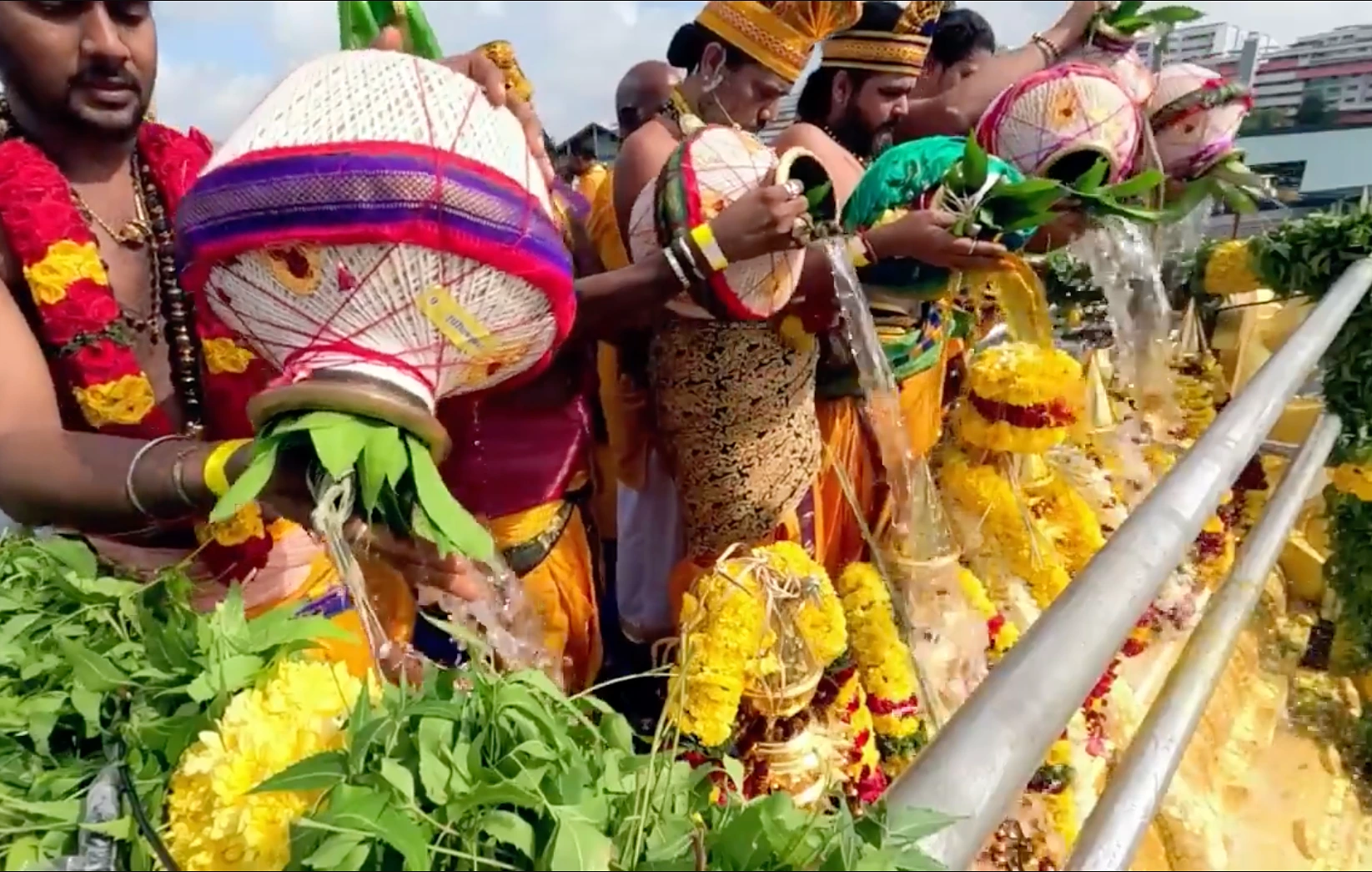
In June 2026, the Sree Maha Mariamman Temple in Yishun entrusted ATEAM Productions with the multi-camera livestream of its Maha Kumbhabishegam, a once-in-a-generation Hindu temple consecration ceremony marking the completion of the newly reconstructed temple, its Rajagopuram (the grand entrance tower) and additional deity sanctums. The temple committee's goal was clear: a livestream that matched broadcast television quality, so the global Tamil diaspora could witness this sacred milestone as if they were standing in the temple.
This case study outlines the planning and the technical challenges behind the project, and how we overcame them with a 60GHz wireless bridge, SRT and NDI over our own local network, bonded cellular backup and a fully engineered audio and RF system.
What Made This Event Hard to Produce
Extreme Heat in the Sanctum
The garbhagriha (inner sanctum) is a small enclosed stone room with dozens of oil lamps (deepam) burning continuously and no ventilation, where temperatures easily exceeded 45°C. In previous temple productions, our PTZ cameras had overheated and shut down at critical moments, so we needed a camera that could survive this environment for hours.
Crowd-Induced RF Congestion
When thousands of devotees arrive, their phones crush the local wireless spectrum: Wi-Fi networks collapse, cellular towers congest and wireless video transmitters lose signal. At our last temple event, wireless video transmitters dropped out and SRT feeds over Wi-Fi failed as the crowd peaked. We needed transport that was immune to crowd interference.
Multi-Location Coverage
Rituals ran in several places at once: the tentage (yajnashala) housing the homa fire rituals, the temple's inner halls, the sanctum and the gopuram exterior, with a public road between the tentage and the temple. Running cables across that distance, through foot traffic and sacred procession routes, was a major challenge.
The Climax Happens Once
The kumbhabhishekam, the pouring of sacred water over the gopurams, happens exactly once, between 10:00 am and 10:30 am. No second takes and no rehearsals, so every camera covering it needed redundant transport and there could be no single point of failure.
Roving Camera Through a Dense Crowd
During the Gadam procession, priests carry sacred items through the compound followed by hundreds of devotees. Our roving camera operator had to move freely through the crowd while keeping a stable feed to the switcher, exactly where cellular and Wi-Fi connections are weakest.
Contractors on Site
Contractors were working on power, tentage and staging at the same time, so the risk of a cable, including the internet line, being cut by accident was real.


How We Solved It
A 60GHz Network Backbone Immune to the Crowd
The heart of the production was a Ubiquiti UBB (Building-to-Building Bridge), a 60GHz point-to-point wireless bridge that created a 1.7 Gbps dedicated link between the tentage and our main production control room inside the temple.
60GHz works on a completely different band from consumer Wi-Fi (2.4/5GHz) and mobile networks, so the crowd's phones cannot interfere with it. Across 179 metres it held 91% link quality with zero packet loss, zero retries and zero dropped frames, on both the 60GHz primary radio and the 5GHz backup radio. Every camera feed from the tentage reached the switcher without touching congested wireless spectrum.
The bridge was managed alongside our Ubiquiti UniFi network: a UDM Pro gateway, a USW Pro PoE 24-port switch and a U7 Outdoor access point, all visible and controllable from a single dashboard on a phone during the event.
The Right Camera in the Right Place
We placed 10 cameras around the compound, each chosen for the demands of its position.
Inside the temple and the tentage, Sony PXW-Z190 broadcast camcorders with 25x optical zoom, alongside a Panasonic AG-UX180 at the homa fire rituals, fed SDI into a Blackmagic DeckLink Duo 2 capture card on a dedicated tentage production PC. The feeds were converted to NDI and crossed the UBB bridge wirelessly to our main vMix switcher.
A Sony PXW-Z190 at an elevated point across the road from the temple was zoomed to its full 25x optical (736mm equivalent) on the Rajagopuram kalasam: the hero shot for the water-pouring climax.
For the sanctum deity shot, we used a compact camera hardwired over a single network cable, with no battery, no Wi-Fi radio and no internal recording, so it generated as little heat as possible in the deepam environment.
Wide Angles from Out-of-Reach Positions
Three GoPro Hero 13 Black cameras with Media Mods added wide-angle coverage from elevated positions. Each was flashed with GoPro Labs custom firmware, set with a single QR code scan, so it boots on USB power, starts in video mode and outputs clean HDMI with a linear lens profile, with LEDs off and no on-screen overlays. No on-site configuration was needed.
Their HDMI outputs went through Blackmagic Micro Converter HDMI to SDI adapters into a Blackmagic 2110 IP Converter 3x3G, so all three feeds travelled down a single Cat6A cable. A matching 2110 converter at the production station turned them back into three independent SDI feeds for the DeckLink card. One cable replaced three, which kept wiring out of sacred spaces.
Roving and Flexible Camera Inputs
For the Gadam procession, a MineMedia Q8S bonding encoder pushed SRT over the mobile network to MineMedia's Singapore bonding server, and vMix pulled the feed from the server, with no port forwarding or public IP needed. A 2.2-second latency buffer smoothed out the changing cellular conditions while the operator moved through the crowd.
A YoloBox Ultra, a last-minute addition that proved its worth, pushed SRT directly to vMix on the local production network and ran on battery power throughout the event.
We also built custom Raspberry Pi 4 SRT streamers: credit-card-sized computers running headless Linux and FFmpeg, PoE-powered, that boot and start pushing SRT video to vMix within 30 seconds of receiving power. Boot scripts, encoding, auto-reconnect and monitoring were all designed so that nothing was needed on site beyond plugging in power.
SRT Over the Local Network, Not the Cloud
At earlier events we had routed cameras through an SRT relay server, which added an internet round trip for cameras only metres from the switcher. This time vMix was the SRT listener on the local production network and each encoder pushed straight to it, so on-site feeds did not depend on the internet at all. The only part that needed the internet was the final stream output.
Audio That Never Depends on Video
Ceremony audio ran on a completely separate path from the video. A dedicated XLR cable carried the tentage audio mixer output, with the mantras, nadaswaram, thavil and bells, straight to the vMix station's audio input. If a video feed dropped, from a camera failure, an encoder crash or a network interruption, the sound carried on. For viewers, a momentary camera switch is invisible; an audio dropout is not.
Front of House and Wireless Microphones
The audio centrepiece was an Allen & Heath Avantis digital console with an Allen & Heath GX4816 stage box: 64 input channels with full processing and scene recall, for a ceremony that moved between intimate priestly chanting and full-scale outdoor reinforcement. SoundTools CAT Tails snake systems ran analogue audio over Cat5 across the compound to keep cable runs manageable.
We ran 6 Shure QLXD wireless channels. The main priest (Sivachariyar) wore two QLXD belt packs at once, one with a Shure MX153 headworn microphone and the second as a live standby, giving instant failover against a flat battery, a loose cable or an RF dropout during the critical chanting. Four more QLXD channels with Shure Beta 58A capsules went to the emcees, who roamed freely from the tentage to the temple interior, around the gopuram and through the crowd.
RF Coverage Across the Whole Compound
Six RF Venue Diversity Fin antennas gave overlapping coverage zones across the grounds, and four CP Beam directional antennas covered long range, aimed at the gopuram, where the priest ascends to pour the sacred water, and along the procession routes. All antennas fed a 4-zone antenna combiner, so every receiver could hear every transmitter wherever the talent walked, and an RF Venue distro fed the QLXD receivers with proper gain staging. A single wireless dropout during the consecration chanting would have been heard by thousands of viewers.
Sound and Screens for the Crowd on Site
Eight Axiom Audio speaker clusters covered the compound: AX12C full-range cabinets for main coverage, AX6C compact units for fills and SW2100A subwoofers, giving even coverage from the tentage to the temple forecourt without excessive volume from any single point.
Four IP-rated Gloshine LED video walls, each 5 metres wide by 3 metres tall, showed the live programme around the compound, protected against the morning sun and possible rain. Twelve 60-inch screens covered the VIP tents and the VIP food area. No one on site was ever more than a few metres from a screen showing the ceremony.
Live Switching, Colour and Recording
All feeds converged on a vMix Pro workstation running at 1080p30, which handled switching, colour correction, audio mixing, graphics, MultiCorder ISO recording of every input and the programme output to YouTube Live and Facebook Live.
Colour was corrected live with the vMix Colour Adjust RGB sliders to cancel the warm orange cast of the tungsten and oil lamp lighting. The grey granite pillars were our neutral reference: once the stone read as natural grey, the gold ornamentation, deity decorations and colourful saris all fell into place.
Backed-Up Internet
The stream ran on the temple's in-house fibre broadband through the UDM Pro gateway. A LiveU Solo provided a bonded cellular backup path, set for automatic failover at the UDM Pro, so if the fibre dropped, from an ISP outage or a contractor cutting a cable, the stream would switch over invisibly to viewers.
Crew & Timeline
Setup and Testing
A two-day window for full rigging, cabling and end-to-end testing before the first ceremony day.
Preparatory Rituals
12 days of preparatory rituals, from 7 to 17 June 2026.
Main Consecration Day
18 June 2026, more than 15 hours: from the early morning rituals through the 10:00 am climax to the evening Thirukalyanam procession.
We had a two-day window for full rigging, cabling and end-to-end testing before the first ceremony day: mounting all cameras, running fibre and Cat6A, aligning the UBB bridge, deploying the eight PA clusters, installing the four LED walls and twelve screens, setting up the RF antenna system, and checking every camera feed from source to vMix output. Every transport path (SRT, NDI, HDMI via the 2110 converters and the UBB bridge) was tested under load. Issues found in testing, such as GoPro Media Mod contact problems, Raspberry Pi Wi-Fi driver failures and frame rate mismatches on capture cards, were fixed before they could affect the live production.
Crew on the Main Day
The eight standby crew provided rotating relief across the long day, managed cables during processions, monitored remote camera positions and responded to any equipment issue, so no operator ever had to leave their post.
The Results
The livestream ran continuously through the main consecration day. The UBB 60GHz bridge held zero packet loss throughout, and the colour-corrected interior feeds faithfully showed the gold ornamentation and the colours of the ceremony.
Most importantly, the kumbhabhishekam, the sacred water pouring over the Rajagopuram, was captured cleanly from multiple angles and streamed without a single dropout, drawing more than 26,000 combined live views (14,000 on YouTube and 12,000 on Facebook) from devotees in Singapore, India, Malaysia, Sri Lanka, the UK, the US, Canada, Australia and across the global Tamil diaspora. For many, particularly elderly devotees and those unable to travel, it was their only way to witness this moment at their family temple.
What This Means for Your Event
Plan for the crowd
Thousands of phones will overwhelm Wi-Fi and mobile data. We keep cameras on our own wired network and a 60GHz bridge, so the crowd cannot take the stream down.
Back up whatever cannot fail
Separate audio paths, a standby microphone pack for the key speaker, and backup internet that takes over automatically.
Use the right camera for each position
Broadcast camcorders with proper thermal management for the critical positions; compact cameras only where their size is essential and a lost feed is acceptable.
Bond more than one network for roving cameras
A single SIM struggles in a dense crowd. For future procession coverage we will bond multiple SIMs across different carriers (Singtel, StarHub and M1).
Test everything end to end
A full rehearsal with every camera, encoder and transport path live at once surfaces the problems while there is still time to fix them.
Equipment List
Cameras
- Broadcast Camcorders: Sony PXW-Z190 (×2, 25x optical zoom), Panasonic AG-UX180, Panasonic AG-UX90
- Cinema Cameras: Sony FX6, Sony FX3 (×2)
- Wide Angles: GoPro Hero 13 Black with Media Mods (×3), on GoPro Labs firmware
- Total: 10 cameras across the compound
Vision Mixing & Streaming
- Switching: vMix Pro at 1080p30, with MultiCorder ISO recording of every input
- Capture: Blackmagic DeckLink Duo 2
- IP Video: Blackmagic 2110 IP Converter 3x3G (×2), Blackmagic Micro Converter HDMI to SDI
- Encoding: MineMedia Q8S bonding encoder, YoloBox Ultra, Raspberry Pi 4 SRT streamers (×2)
- Destinations: YouTube Live and Facebook Live, simultaneously
Audio & RF
- Mixing: Allen & Heath Avantis digital console, Allen & Heath GX4816 stage box
- Audio Snakes: SoundTools CAT Tails snake systems (analogue audio over Cat5)
- Wireless Microphones: Shure QLXD (×6 channels), Shure Beta 58A capsules (×4), Shure MX153 headworn (×1), double belt pack set-up for the main priest
- RF Management: RF Venue Diversity Fin antennas (×6), CP Beam directional antennas (×4), 4-zone antenna combiner, RF Venue distro
- PA System: Axiom Audio AX12C (mains), AX6C (fills), SW2100A subwoofers, 8 clusters in total
Networking & Cabling
- Gateway: Ubiquiti UDM Pro, with dual WAN failover
- Switching: Ubiquiti USW Pro PoE 24
- Wireless Bridge: Ubiquiti UBB 60GHz Building-to-Building Bridge (1.7 Gbps, 179m, 5GHz backup radio)
- Wi-Fi: Ubiquiti U7 Outdoor Wi-Fi 7 access point
- Backup Internet: LiveU Solo (bonded cellular), primary on the temple's fibre broadband
- Cabling: Ubiquiti SFP modules, fibre media converters, tactical fibre and Cat6A, dedicated XLR audio line
LED & Displays
- LED Walls: Gloshine IP-rated LED video walls (×4, 5m × 3m each)
- Displays: 60-inch screens (×12) for the VIP tents and VIP food area
Power
- Power over Ethernet: Raspberry Pi SRT streamers were PoE-powered (power and data on one network cable)
- USB Power: GoPros boot automatically when USB power is applied
- Battery: YoloBox Ultra ran on its own battery throughout the event
Frequently Asked Questions
Can you livestream a temple ceremony when thousands of devotees are on site?
Yes. Crowds overwhelm Wi-Fi and mobile data, so at the Sree Maha Mariamman Temple Maha Kumbhabishegam we kept all on-site cameras on our own local network and linked the tentage to the control room with a 60GHz wireless bridge, which phones cannot interfere with. It held zero packet loss across 179 metres for the whole day.
How do you make sure a once-only moment is not missed?
We put redundancy on every critical link: multiple camera angles, audio on its own cable separate from the video, a standby wireless pack on the main priest, and backup internet that takes over automatically. For the sacred water pouring, a camcorder at full 25x zoom covered the top of the Rajagopuram from across the road.
Can you film in hot, enclosed spaces like a temple sanctum?
Yes. In a sanctum above 45°C, we used a compact camera hardwired over a single network cable, with no battery, no Wi-Fi radio and no internal recording, so it produced as little heat as possible.
Can you stream to YouTube and Facebook at the same time?
Yes. Our vMix workstation sent the same programme to YouTube Live and Facebook Live simultaneously, and recorded every camera separately. The temple livestream drew more than 26,000 combined live views.
Can the livestream be shown on screens around the venue too?
Yes. The same programme played on four 5m × 3m outdoor LED walls and twelve 60-inch screens in the VIP tents and food area, so no one on site was more than a few metres from a screen.
Planning a temple ceremony, community celebration or livestream in Singapore?
Reach out with your date and venue via our enquiry form or contact us directly at bryan@ateam.com.sg. Let's discuss how we can bring your production to life.